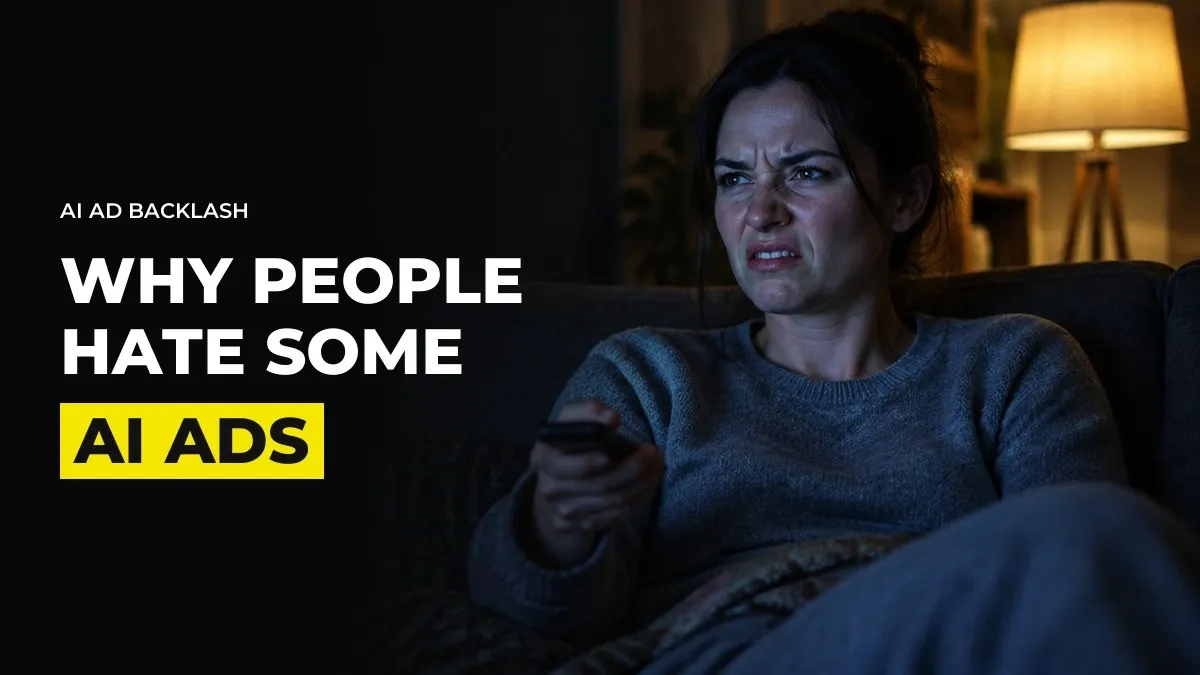
Why People Hate Some AI Ads, and What the Good Ones Do Differently
You might be about to put an AI ad in front of a client and worrying that the comments will turn on it. People do turn on some AI ads, and the reasons are specific. Once you know them you can check your own work against the list before anyone else sees it.
The loudest examples are public, so we can look at what viewers actually said.
People react to what is on the screen, and the tool comes second
When Coca-Cola ran its AI remake of "Holidays Are Coming" in November 2024, reports quoted viewers calling it "creepy", "dystopian" and "soulless". When McDonald's Netherlands released its AI Christmas film in December 2025, NBC News quoted people calling it "unsettling" and "so cynical and unfun". One viewer wrote, "Regardless of being made with AI, this is just a bad idea for a commercial."
That last comment is the useful one. Nobody wrote that the pixels were wrong. They wrote that the idea was bad. The tool gets blamed because it is the easy thing to name.
Five things make an AI ad easy to hate
Generic faces. The same smooth, symmetrical face with the same blank smile. Viewers cannot say what is wrong, they just feel it. We wrote about the cause in why AI characters look plastic.
No story. A sequence of nice-looking shots with nobody wanting anything. Beautiful and forgettable is the default result when you prompt shot by shot with no idea behind it.
It looks cheap. Mostly this is sound and direction. Stock-sounding effects, music the model added by itself, a camera that floats the same way in every shot.
Too many messages. The viewer is asked to feel three things and buy one. They leave feeling none.
The wrong tone for the brand. The McDonald's film told people to hide from Christmas inside a restaurant. A bleak joke that felt cold on screen.
Only the first two are really about AI. The other three show up in ads shot on a camera too.
The good ones start with a story and one message
An AI ad that works is built like any ad that works. One person, one want, one thing in the way, and one line the viewer takes away. We write a one page idea document first, with the core message at the top and a list of what could be interesting about it. Generation comes after that, and it is the smallest part of the job.
For example, a running shoe ad that opens on the shoe spinning in a void is a spec sheet. A runner with sore feet getting home and taking her shoes off is a story, and the shoe is the relief.
They sell the benefit and leave the specs for the client's page
Nobody remembers that a sole is 8mm. They remember not having sore feet after a run. Say the benefit in plain words and let the picture prove it. If the client insists on a spec, weave it into the benefit instead of reading it out.
They direct every shot like it was on a set
This is the biggest gap between ads people shrug at and ads people share. A directed shot has a size, a lens feel, a camera move and an acting note with timing in it. "He looks surprised" gives you a stock face. "He freezes, eyes drop to the envelope, a half second later he swallows" gives you a performance.
Vary the shot sizes, cut to a reaction, and hold the shot that matters a little longer than feels comfortable. Then do the sound by hand. We cover that part in why sound gives AI footage away first.
They are honest about what AI did
Tell the client what was made with AI and what was shot, before the cut goes out, so nobody has to find out from the comments. And be ready for the question, because every client asks it eventually. For example, inside GenHQ we teach the specific fix behind each client note, because "we will make it more human" is not an answer to "why does this look AI?".
Run the same check on your next ad
Put the cut on a phone, turn the sound off and ask whether the story still makes sense. Then turn the sound on and ask whether you would believe it if you did not know how it was made. If either answer is no, fix that before you export. The part most people leave until last is the one that gives it away first.
Common questions
Why do people hate AI ads?
Mostly because of what they see. Generic faces, no story, cheap-feeling sound and an idea that does not fit the brand. The reaction to the Coca-Cola and McDonald's ads came down to those, not to the software.
Is it bad to use AI in a commercial?
No. It is bad to use it with no idea behind it. Plenty of viewers will accept an AI ad that tells a clear story and feels directed.
What makes an AI ad look cheap?
Usually the sound and the lack of direction. Default model effects, the same camera move in every shot and faces that never react.
How do you stop an AI ad feeling generic?
Write the idea first, keep to one message, sell the benefit and direct each shot on purpose.
Keep reading
Can You Use AI Video in Paid Ads? Commercial Use, Copyright and Music in 2026
How to Turn 3D Architectural Renders Into a Realistic AI Walkthrough
Want to learn this with people making ads every week? Join GenHQ.