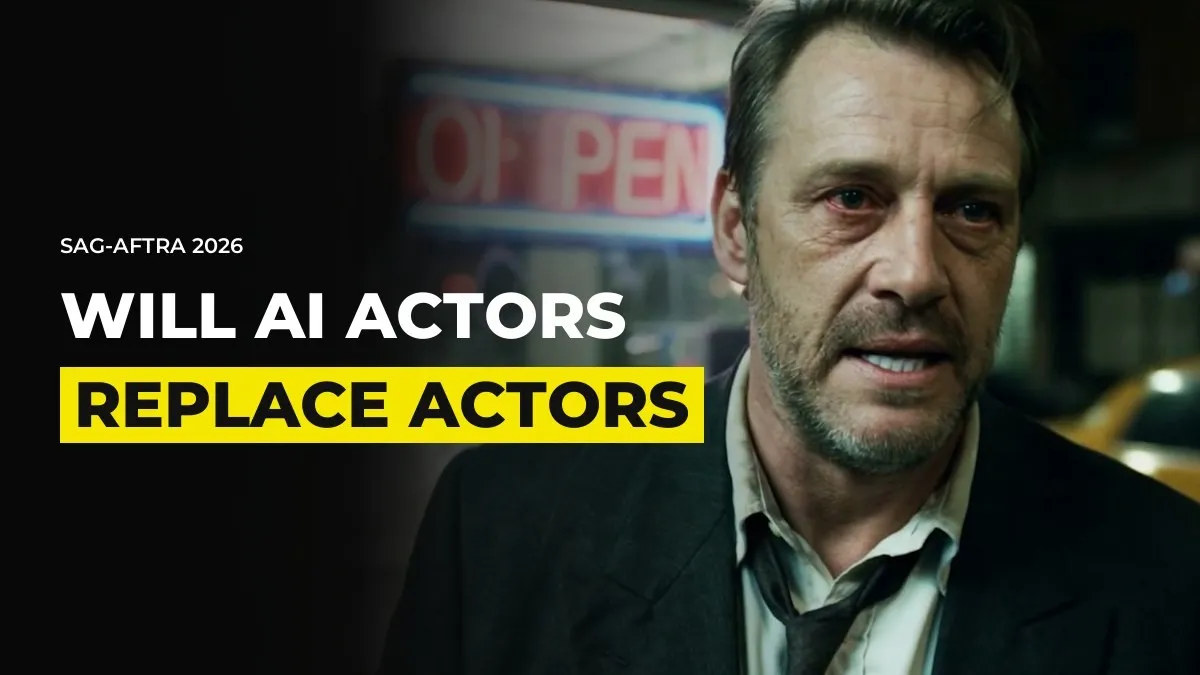
Will AI Actors Replace Real Actors? The 2026 SAG-AFTRA Rules Explained
You might be a brand manager who wants an AI spokesperson, or an AI creative whose client just asked whether that is allowed. Here is the short answer. The 2026 SAG-AFTRA television and theatrical contract does not ban AI actors. It makes a producer justify using one, tell the union first and bargain over it.
Below is what the contract says, in the union's own documents, and what it means for anyone making AI performers for work.
What the 2026 contract says about synthetic performers
SAG-AFTRA members ratified the new TV and theatrical agreement in June 2026, according to the union's AI timeline. The AI terms are in the 2026 Memorandum of Agreement.
The contract defines a "Synthetic" as a digitally created asset that meets all four of these tests:
It creates the clear impression of a natural performer who is not recognisable as any identifiable natural performer.
It is not voiced by a natural person.
It is not a digital replica of a real performer.
No employment arrangement exists with a natural performer in the role the asset portrays.
It covers motion pictures that begin principal photography on or after 1 July 2026. In the contract the producers agree to "a principle strongly favoring human performances". They say they do not intend to use a Synthetic in a human role unless the producer reasonably concludes it "brings significant additional value to the motion picture". The union's AI explainer sums it up as no Synthetic in a human role unless it brings significant additional value compared to a digital replica.
What a producer has to do before using one
The process is spelled out step by step:
The producer gives the union prior written notice that it intends to use a Synthetic in a role a human would otherwise play.
Within ten business days of that notice, the producer and the union meet to bargain in good faith over the use and any appropriate payment.
If they have not agreed, the contract sets time limits, with the bargaining period ending no later than twenty business days after the notice.
Any payment that is bargained or awarded goes to the SAG-AFTRA Health Plan or the relevant pension plan.
The Synthetic section runs until 30 June 2030. For digital replicas of real performers, the contract also says a producer must have an "articulable business reason" when asking a performer to be scanned.
What the commercials contract says, because most AI work is advertising
If you make ads, the 2025 commercials agreement matters more than the film one. The union's 2025 Commercials Contract MOA has its own rules for synthetic performers:
A producer must not use a Synthetic Performer "primarily or materially for reasons of economy or economic advantages in the engagement of performers".
If it does, the producer pays the economic equivalent of what a human would have been paid into the union's health and pension plans.
When a synthetic performer appears in a commercial with at least one human principal performer, the producer pays 1.5 session fees plus contributions within thirty days of the first air date.
When a commercial uses only synthetic performers, the producer and the union negotiate in good faith over the contribution.
What this means if you make AI performers for clients
These contracts bind the producers who have signed them. They do not bind you personally, and they do not cover every ad on social media. But a brand or agency that works under a SAG-AFTRA contract has obligations, and their legal team will ask you questions. Be ready to answer these:
Is the performer a fully invented character, or does it resemble a real person? A lookalike of a real performer is a different problem from a synthetic one.
Was any real person's face, voice or image used as a reference? Do you have written consent?
Is the AI character replacing a role a human would have played, and why does it add value?
Keep a simple record for every performer you make: the character sheet, the references and where each one came from. If a client has to file a notice with the union, that record is what they will need.
Will AI actors replace real actors?
For union productions, the contract makes replacement something a producer has to argue for and negotiate. That raises the cost of choosing AI purely to save money. Outside those productions, the market is deciding. Audiences have shown they will turn on AI ads that feel generic, and a character with a story and a specific face holds up much more.
Our view is that the creatives who do well are the ones who direct. A performance still needs a reason, a point of view and a cut to the reaction. Those come from a person. If you want to see how that directing is done, our guide on why AI characters look plastic is a good start.
For example, inside GenHQ members build character sheets for invented performers and keep their references on file, which is the habit that makes a client conversation about AI actors simple.
This is not legal advice. Read the union documents linked above and ask a lawyer who knows entertainment contracts before you sign anything for a union production.
Common questions
Are AI actors banned under the 2026 SAG-AFTRA contract?
No. Producers agree to a principle strongly favoring human performances and must give the union written notice and bargain before using a Synthetic in a human role. The Synthetic section runs until 30 June 2030.
What counts as a synthetic performer?
A digitally created asset that looks like a natural performer but is not recognisable as any identifiable real performer, is not voiced by a real person, is not a digital replica and has no performer employed in that role.
Do the rules cover AI actors in commercials?
The 2025 SAG-AFTRA commercials contract has its own synthetic performer rules, including payments into the union's plans when a Synthetic is used with a human principal performer.
Can I make an AI actor that looks like a real celebrity?
Not without that person's consent. Under the contract a likeness of a real performer is a digital replica, which is a separate category with its own consent rules. Build an invented character instead.
Keep reading
Want to learn this with people doing it every week? Join GenHQ.