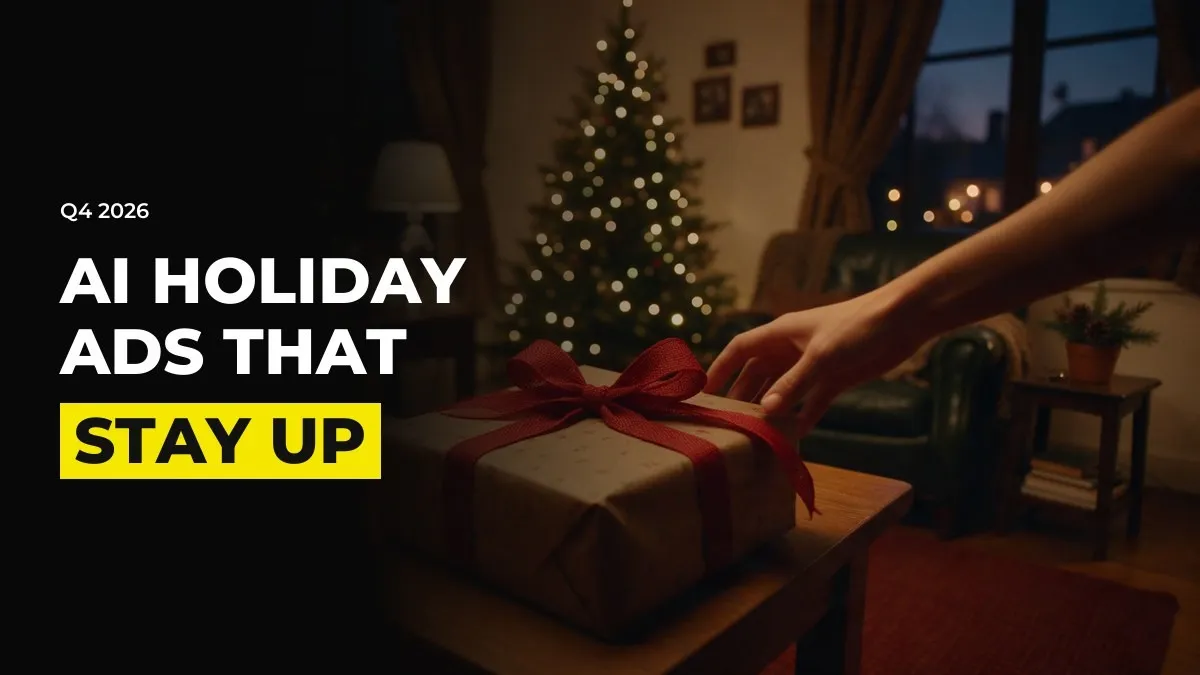
How to Make an AI Holiday Ad That Does Not Get Pulled
You might be planning a Christmas or Black Friday ad and wondering if AI will get you laughed at online. It can. In November 2024 Coca-Cola ran a 15 second AI remake of its 1995 "Holidays Are Coming" spot, and viewers called it creepy and soulless. In December 2025 McDonald's Netherlands put out a 45 second AI Christmas film, and it was taken down within days.
Neither ad failed because it used AI. They failed on choices any creative could have made differently, and you can avoid every one of them.
Look at what actually went wrong in the two ads everyone remembers
Here is what the news reports say, from the coverage I read, not from memory.
The Coca-Cola ad from November 2024 was a convoy of red trucks rolling into a snowy village, with AI-made people and scenery. Critics called it "creepy", "dystopian" and "soulless", and said it lacked the feeling of the human-made originals.
Coca-Cola came back in 2025. According to NBC News, after the backlash it avoided showing AI-generated humans up close and used computer-generated polar bears, rabbits and squirrels instead.
The McDonald's Netherlands film, "the most terrible time of the year", was 45 seconds of holiday disasters. Santa's sled stuck in traffic, a man hanging from his Christmas lights, a woman dragged by a tram. It ended by telling viewers to hide out in McDonald's until January.
Viewers called the McDonald's film "unsettling" and "cynical". One wrote, "Regardless of being made with AI, this is just a bad idea for a commercial." McDonald's Netherlands removed it and its statement said the moment was an important learning as it explores the use of AI.
Read that list again. One ad had faces that felt wrong. One had a message that felt wrong. And the Coca-Cola animals suggest the brand took the faces to be the problem.
Start with a human story and let AI build the world around it
A holiday ad sells a feeling. Warmth, relief, being home. Before you open any model, write one sentence about a person and what they want. A dad who is late home. A kid waiting at a window. A grandmother's recipe.
Then decide what AI should make. It is very good at things that are expensive to shoot: a snowy street at golden hour, a table that stretches the length of a hall, your product sitting inside an impossible winter scene. It is weak at the thing a holiday ad lives on, which is a believable face reacting to another face.
For example, you could shoot one real moment with a real family member and a phone, and build everything around that moment with AI. The audience gets one real face and a world that looks expensive.
Keep faces few, close and consistent, and skip the crowd
Crowds are where AI ads give themselves away. Twenty villagers means twenty chances for a stiff smile or a hand with the wrong number of fingers. Use one or two characters and give each a proper character sheet so the face stays the same from shot to shot. We cover why crowds break and what to do about it in our guide to crowds and multiple characters in AI video.
If you do not want to carry faces at all, take the Coca-Cola route and tell the story with animals, objects or hands. A pair of hands wrapping a gift is a whole scene and nobody will question it.
Have one idea and say it in one line
The McDonald's film had a lot happening and one message that confused people. Your ad needs a line you can say in a breath. "Come home." "Make room at the table." Every shot should earn that line or go.
A quick test. Show the cut to someone for the first time with the sound on and ask what it is about. If they need more than one sentence, you have two ideas.
Do the sound yourself
A silent, beautiful holiday ad with generic effects on top is how you end up with "soulless". Strip the model's default music and effects and build the sound from scratch. Real bells, a room tone, a single warm music cue. We go through it in why sound gives AI footage away first.
Direct every shot and be straight with the client about the AI
Choose the shot size, the camera move and the acting note for each shot. A shot with no direction looks like a stock library clip, and viewers feel that before they can say why. And if a brand asks, say plainly what was made with AI and what was shot.
Budget honestly too. A first AI video job for a client starts at $500 to $800 and the floor is $500, and a holiday spot with proper sound and direction sits well above it. There is a full breakdown in what an AI ad costs to make in 2026.
For example, inside GenHQ the ad work starts with the idea document and the script before any generation, because that is the step that decides whether the ad has a point.
Check the finished ad against the two that got pulled
Before you deliver, ask three questions. Is there a face in this that I would be embarrassed to see in close up on a cinema screen? Can I say the idea in one line? Would I leave the sound on if the picture were taken away? If any answer is no, fix that shot first, and then look at the music. The music is where most people stop checking.
Common questions
Can you use AI for a Christmas ad?
Yes. Coca-Cola and McDonald's both did, and both got criticism for the execution, not for the tool. Keep the story human, limit the faces and direct each shot.
Why did people hate the Coca-Cola AI Christmas ad?
Viewers called the 2024 spot creepy and soulless, mainly because the AI-made people and the lack of emotion felt wrong against the human-made originals. In 2025 the brand used animals instead of close-up human faces.
Why did McDonald's pull its AI Christmas ad?
The Netherlands film showed Christmas going wrong and told people to hide out in McDonald's until January. Viewers called it unsettling and cynical, and the company removed it in December 2025.
When should you start a holiday ad made with AI?
Now, if it needs to run in December. Allow time for a script, character sheets, several runs per scene, sound and a client round of changes.
Keep reading
Why People Hate Some AI Ads, and What the Good Ones Do Differently
Can You Use AI Video in Paid Ads? Commercial Use, Copyright and Music in 2026
Want to make ads like this with people doing it every week? Join GenHQ.