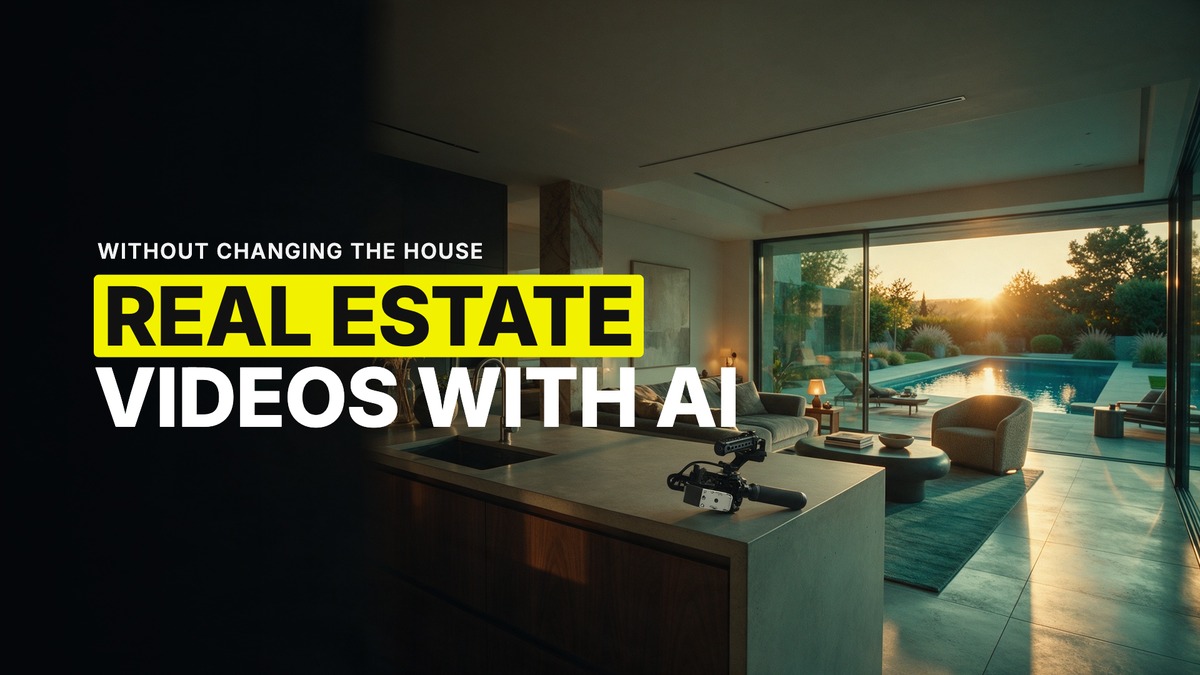
How to Make Real Estate Videos With AI (Without Changing the House)
Real estate is the clearest commercial opening we see in AI video right now, and it is also the strictest. An agent, a broker or a developer does not want a creative reinterpretation of their listing. They want the actual house, the actual bed, the actual kitchen, moving on screen instead of sitting in a static photo gallery. Get that right and you have a repeatable service a local agency will pay for every month. Get it wrong, even in a small way a homebuyer would notice, and you have handed them a video they cannot use.
The brief we set our community this week, our $100 Weekly Challenge "The Agent," asks creators to produce a 20 to 30 second property tour with an agent talking to camera, standing inside a real house from a real listing. The brief is deliberately unforgiving: nothing in the property may change. The bed stays where it is. No invented fireplace. No new rooms that were not in the photos. That constraint is not a limitation of the tools, it is the actual job.
The one rule that breaks more real estate videos than any other
Match your aspect ratio to the reference photo. If your listing photo is 16:9, generate at 16:9. If you feed a 4:3 or a vertical photo into a 16:9 generation, the model has to invent everything outside the edges of what you actually photographed, and it will invent a bookshelf, a door, a window that does not exist in the real room. This single mismatch is the number one reason these videos fall apart, and it is also the easiest one to avoid, because it costs nothing to just check before you generate.
What you can move and what you cannot
Inside the frame you photographed, you have almost no room to invent. Outside strict geometry, you have more freedom than people assume. Light, weather and time of day are all fair game, you can take a room from midday to golden hour, or bring rain onto the window, without touching a single fixed object in the shot. A dog on the floor, a car in the driveway, a fan turning, curtains moving in a breeze, all of it is fine, because none of it changes what a buyer sees when they walk through the actual door. What is not fair game is anything that changes the property itself: the size of a room, the position of a sink or a stove, a wall that was not there, a pool on a side of the house where there isn't one. The test is simple. If a buyer showed up in person and something looked different from the video, you have broken the listing, not just the shot.
Lip sync and sound are half the job, not an afterthought
An agent talking to camera inside a real room is a dialogue problem before it is a real estate problem. If the voice performance is flat, or the mouth movement drifts from the audio, the video reads as fake regardless of how well the room held together. Treat the agent's delivery with the same care you would give a character in any other AI video, a clear voice reference, natural pacing, and lip sync that actually matches what's being said, because a viewer forgives an imperfect wall a lot faster than they forgive a mouth that doesn't match the words.
The renovation angle, and why it has to stay honest
A workflow some of our creators run for renovation and staging work follows a version of the same discipline in reverse. Start from a real photo of the property as it is now, then generate the after image, keeping the room's actual shape, the actual camera angle, and critically, the actual position of things like the sink and the cooker. If the plumbing fixtures move between the before and the after, the renovation stops reading as plausible, because anyone who has ever priced a remodel knows moving a sink is a different job entirely from repainting a kitchen. Keep the bones of the room fixed and change only the finish, and the before/after sells itself.
What actually makes it usable by an agency
A well-made clip is not automatically a deliverable. An agency needs a few things wrapped around the footage before they can put it in front of a client: a branded open and close, the address and the price on screen at some point in the video, and a clear line for who to call. None of that is creative work, and all of it is what separates a demo reel from something an agent actually posts. Build that packaging into your process from the start rather than bolting it on at the end, because it is usually the difference between a spec piece and a paid one.
The opportunity underneath all of this
What makes this a real commercial lane rather than a novelty is the volume. A local agent has a new listing most weeks, sometimes several. Once you have a working process, an agent-led tour is a repeatable product, not a one-off project, and it is one of the few AI video categories where the client's expectations are simple to state and easy to check: does the house on screen match the house on the market. Get that right consistently and you are not competing against other AI creators, you are competing against a real estate photographer's day rate.
Common questions
How do I make a real estate video with AI without changing the property?
Match your generation's aspect ratio to your reference photos exactly, keep fixed elements like walls, room shape and plumbing fixtures untouched, and limit your changes to things that do not alter the property itself: lighting, weather, time of day, small movement like curtains or a pet on the floor.
Why do AI real estate videos look fake even when the room looks right?
Usually the lip sync or the voice performance of the agent on camera, not the room. Treat the talking agent as seriously as you would treat a character in any dialogue-driven AI video.
Can I use AI to show a renovation before and after?
Yes. Start from a real photo, keep the room's shape, camera angle and fixture positions like the sink and cooker unchanged, and change only the finish. If the plumbing appears to move, the before/after stops being believable.
What do real estate agencies actually need beyond the raw video?
A branded open and close, the address and price on screen, and a clear call to action for who to contact. Without that wrapper, the footage is a demo, not a deliverable.
Want the full method and the community that runs it every week? Join GenHQ.