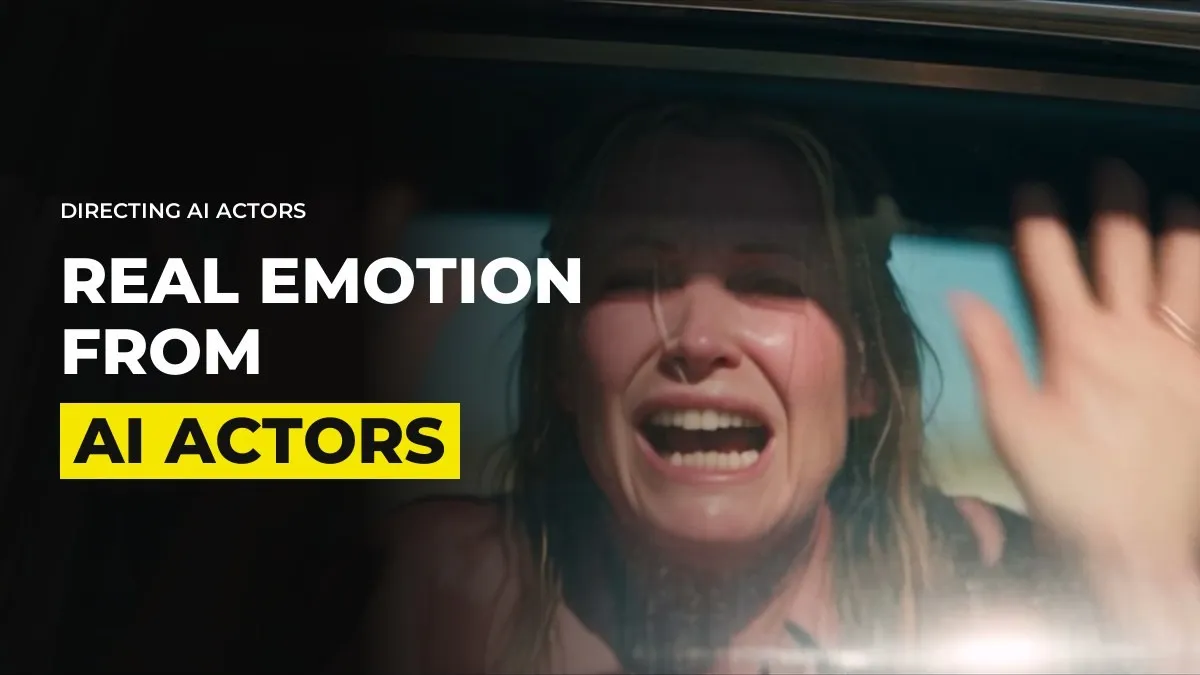
How to Get Real Emotion From AI Actors (Close-Ups and Reactions)
You might have a character who is supposed to be heartbroken and a render where he looks mildly inconvenienced. That is the most common problem we see in AI film. The face is sharp, the lighting is lovely and nothing is happening behind the eyes.
Three changes fix most of it. Get closer, describe the face exactly, and let someone else's reaction carry the feeling.
Shoot emotion in a close-up or a medium shot
A wide shot captures the energy of a room. It does not capture what one person is feeling. If the emotion is the point of the shot, frame the face, or at most the head and shoulders.
There is a second benefit. The model handles expression more reliably when the face fills the frame, and the viewer can read it at a glance. We see pieces where the key emotional line is delivered in a wide shot, or with half the face hidden behind a phone, and the scene goes nowhere. Re-framing to a close-up is the first thing to try.
Describe the face, not the feeling
If you write "he looks scared" you get the model's default scared, which is the same open mouth and wide eyes everybody else gets. Name the parts of the face instead. For example:
What the eyebrows do, and whether they pull together or lift in the middle.
Where the eyes go, and whether they hold on something or flick away.
What the mouth does, and whether it is tight, slightly open or trembling.
What the breathing does, and whether it is held or shallow.
How long the expression takes to arrive, and whether it builds or hits at once.
The timing line matters as much as the face. "He laughs" gives you one flat laugh. A line that says he looks down, the corner of his mouth goes first and then the laugh breaks through gives you an actor.
Write it the way a director talks to an actor on set. Short, physical and specific.
Check the character sheet carries the expression
If the character sheet shows a neutral face from five angles, the model has nothing to hold on to when the scene calls for tears. When a reference is too neutral, the render ignores a well written emotion prompt. Add expression to the sheet itself, or add a reference image showing the face you are after. Then the prompt and the reference are pulling the same way.
Do not push the emotion to its maximum
People who have fixed a flat performance sometimes overshoot. The result is a face at full intensity with nothing left to build to. A character who is delighted needs somewhere to go beyond a small smile, but a face that starts at the ceiling reads as fake, and it gets tiring to watch.
Real people hold feelings back. A grieving person does not wail at the camera. They look at the floor and swallow. Soft and specific beats loud and generic every time.
Cut to a reaction shot and let the audience fill in the feeling
This is the one that changes the most. Emotion in film is rarely one person on their own. It needs a person showing it and a person receiving it. When someone cries, you feel it less from the crying than from watching somebody else's face as they see it.
So build the shot pair. First the action or the line. Then the reaction, from another character or from the same one, in a close-up. A punch lands harder when you see the person who threw it, and a mistake matters more when the character realises what he has done. Without that reaction shot, the audience has no payoff for what just happened.
Two details keep it from going wrong:
If you cut to the same angle, only closer, the cut feels like a jump. Change the angle as well as the size.
Keep the continuity. The person reacting has to be in the same position as the last shot, with the same face from the character sheet.
Take the music down under the moment
A track playing at full volume tells the audience how to feel and leaves nothing for the face to do. At the emotional peak, we pull the music right down, or cut it, and leave room tone and breath. The face gets the stage. For example, inside GenHQ we review pieces every week, and a music track fighting a face is a note that comes up again and again.
Once the face is working, there is one more question left. What does the scene sound like when the music stops?
Common questions
Why do my AI characters have no emotion?
Usually the shot is too wide, the prompt names a feeling instead of describing the face, or the character sheet shows a neutral expression. Fix those three and most of the flatness goes.
How do you prompt a specific facial expression in AI video?
Describe the eyebrows, eyes, mouth and breathing, and say how long the expression takes to arrive. Write it like a director talking to an actor.
What is a reaction shot and why use it?
It is a shot of a character responding to something that just happened. It makes the audience feel the moment, because they watch someone else feel it.
Should I use a close-up for every emotional scene?
Use a close-up or a medium shot for the key emotional beats. A wide shot is fine for context, but it will not carry the feeling.
Keep reading
Want to learn this with people making films every week? Join GenHQ.