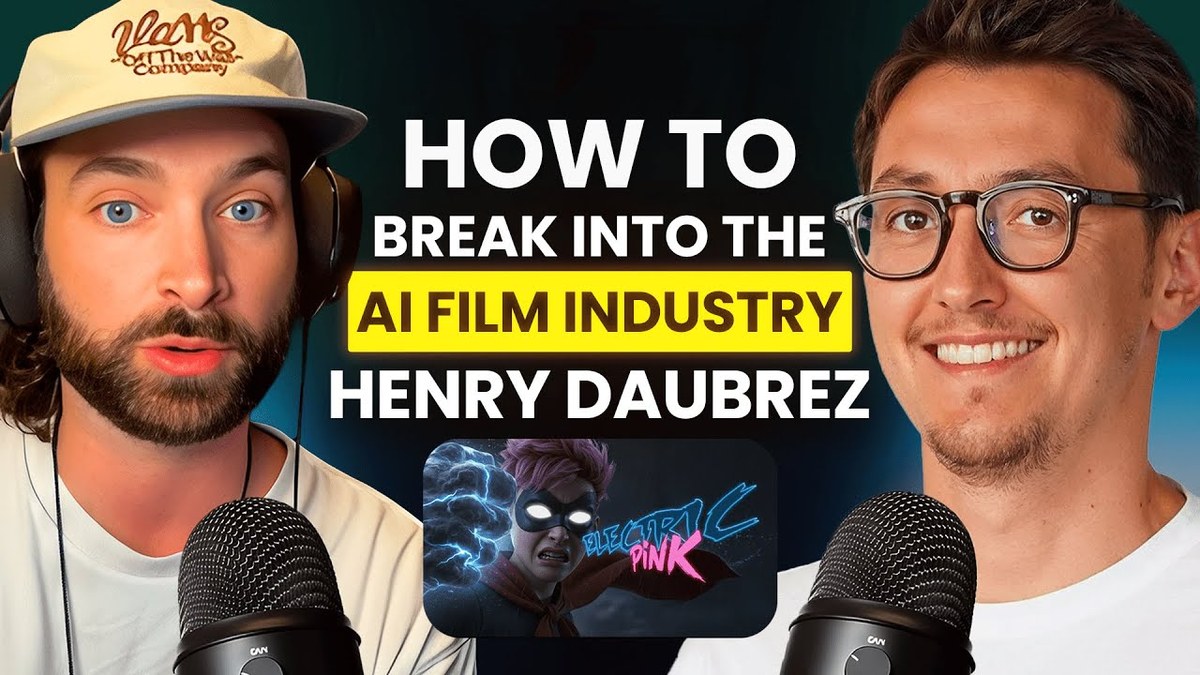
How to Break Into AI Filmmaking (Advice From Google's Resident Filmmaker)
Henry Daubrez is the first resident filmmaker Google Labs has ever had. Before that he spent 18 years building a studio in Belgium that worked for Coca Cola, Hugo Boss, BMW, Marvel, Microsoft and the New York Times, got acquired, and then he left to make films with AI. His short film Electric Pink played at Google I/O.
I sat down with him for an hour inside GenHQ and asked the questions our members ask me most: how do you decide what shot comes next, how do you actually start a project, and how does someone at the beginning of their creative career get found by a company like his. This is the career half of that conversation.
How he got here
He started as a graphic designer, drifted into web design because it paid, and spent nearly two decades trying to make websites tell stories, which is a medium built for information rather than emotion. Four years ago he tried an early AI image app, found it produced something visually weird and nothing like what he asked for, and loved it anyway. For once he was not micromanaging every pixel. He was curating.
Over Christmas 2024 he made a test story about a fox called Kitsune. It was supposed to be a technical test. It became a film, went viral, and studio executives started asking how it was made. Google reached out to ask about his process, then invited him to make a film for I/O. Two months before our interview he left the company he had spent 18 years building and joined Google to work directly with the team that builds their film tools.
That is a career built on one personal project that he finished and put out.
What 20 years of other skills gave him
People tell AI creators they should learn to draw. Henry did. What he brings to AI is not drawing, it is taste built over decades of art direction, design, reading, film and painting. He still opens Photoshop every day, all day, to fix what the models get wrong. And he built Electric Pink shot by shot, generating each frame as a still, photoshopping out every consistency error and artefact, then animating from that frame, and layering sound design and voiceover on top.
He does not call it AI filmmaking. Filmmaking is the thing. AI is one of the tools. If a shot looks like AI and he can fix it, he fixes it, because unfixed shots are food for the people who hate this.
His advice for someone starting today
Fake it until you make it, then do the work. Every big opportunity he took, he knew roughly how he would do it and figured out the rest as he went. Traditional film does not let you pivot mid project because shoots are expensive. AI does. Start, share, adjust.
Feed yourself. Read, watch films, and watch consciously. Notice how the sound design in a scene lands on the beat of the music. Taste is not a gift, it is a diet.
Be honest about who you are. Do not do everything like the director you love. Learn from what you admire and put your own history on the table. Electric Pink is 90 percent things that really happened to him, including the three hours of 1980s adverts his parents recorded on VHS to keep him calm as a small child.
Stop chasing every tool. AI moves fast enough to be disheartening. You can lose days doing research and development and land nowhere. A good story and a clear sense of why you are telling it matters more than the latest model.
Use the tool for what it is good at, not what you wish it did. Everyone's first test is a car chase and it looks bad because the wheels turn wrong. Tell the story the tool can carry today. There are plenty of them.
How to stand out when everyone has the same tools
Look at what everyone else is doing and go in the opposite direction. His words, minus one adjective.
He chose animation because it is expensive in the real world and hard to hold consistent with AI, so almost nobody does it well and it stands out when it works. He points at a film industry where everything is graded flat and safe because nobody will take a risk, and says AI creators have no excuse: you can commit to deep blacks and loud colour because a bold decision costs you nothing but generations.
Kitsune split the audience down the middle. Half loved it, half told him to quit. A year later people still talk about it. Same monster, same starship, same robot uprising, and the audience scrolls past. A point of view is the only thing that survives a feed.
How he actually works
He writes a script first, loose on the early films and tight now, and goes back to it whenever a sequence feels wrong. Before generating anything he builds the world: what it looks like, what it feels like, and which tools can hold that look with a high hit rate. He tests whether changing a few words in a prompt keeps the universe or throws it away, because generating twelve clips to keep one is the mark of a pipeline that does not understand its own model.
His prompts are structured blocks: lens, angle, visual description, mood, motion. He does not bother with JSON. He starts a fresh chat per project so the LLM learns that project's recipe and can apply it to new situations, and he separates the chat for generations from the chat for story.
On shot order, he thinks in contrast. An establishing shot to show the world, then a close up to show how the character feels about it. The test is simple: the viewer never stops to ask where we are or why we are seeing this. Then he cuts, and he starts editing early.
Sound is where he admits he knows least, which is why it is worth repeating. He strips the generated audio from every clip first because it gives the AI away, rebuilds from a stock library, runs everything at about half volume so the layers do not pile up, and fights the too perfect studio sound of synthetic voices with EQ until they sound like a person in a room. Nobody taught him. He asks an LLM when he is stuck.
What this means if you want the job
He got found because of a finished personal film, not a showreel of clips. He has the job because he could explain to a tools team what their model could do that they did not know about. Both of those are available to anyone reading this. Finish something with a beginning, an end and a character who changes. Put it where people are. And keep a folder of what you learned, because the next company that wants to know how you did it will ask.
Common questions
Do I need a film background to become an AI filmmaker?
No. Henry had none. He had two decades of design, taste and storytelling, and he says not being shaped by the industry let him make choices a trained director would not.
What should my first AI film be about?
Something true to you that the tools can carry. Not a car chase, not another robot uprising. His breakthrough was a story about a fox made over a Christmas break.
How do AI filmmakers get hired by companies like Google?
By putting out finished work with a point of view and being able to explain the process. The tools teams often do not know what their own models can do.
Which skills transfer best into AI filmmaking?
Photoshop, art direction, writing, editing and sound. He says the job now rewards being able to juggle all of them at a working level over being elite at one.
Is AI filmmaking a real career path in 2026?
It is for the people who treat it as filmmaking. Henry left an 18 year business for it. Our members have landed roles from studio evaluation leads to agency retainers on the back of finished AI work.
The full interview, including the Electric Pink storyboard walkthrough, is inside the classroom. Join the community.