Do You Still Need to Upscale AI Video in 2026?
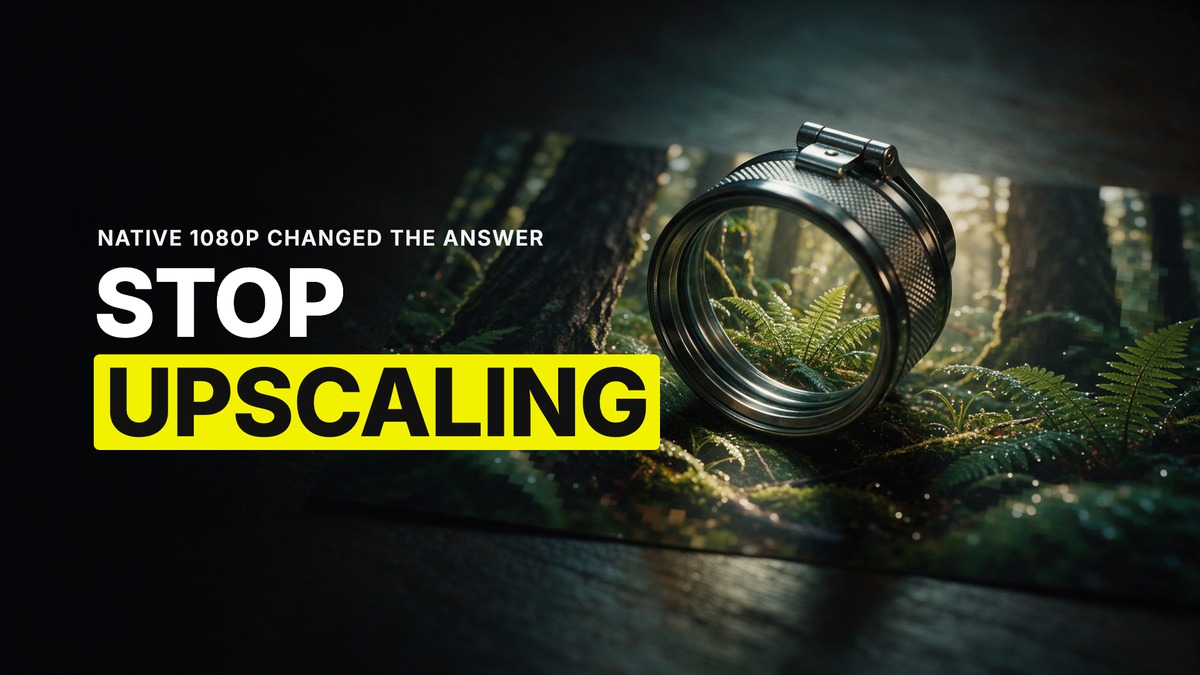
Mostly, no. Upscaling used to be how you got a video model's output up to something watchable, because the models themselves generated soft, low resolution footage that needed help. That is no longer true. Seedance 2.5 generates native 1080p, and once native high resolution arrived, upscaling stopped being my primary option.
That does not mean upscaling is dead. It means it moved from being step one of every project to being a fallback for a specific, narrower set of cases. Here is the honest breakdown, as of September 2026.
Generate native, do not plan to fix it after
The default now is to generate at the resolution you need in the first place. Seedance 2.5 gives you native 1080p, so for client work, the sensible workflow is to test cheap and render final at the resolution the delivery actually calls for, rather than generating low and hoping an upscaler closes the gap. I ran into exactly this trying to salvage a spec ad through Higgsfield's built in tool, then Firefly, then Topaz, and kept getting the same result, files that were technically bigger but visibly distorted, things in the frame warping under the upscale. That is normal now, because upscalers were built for a world where models did not generate high resolution natively, and that world has moved on.
Where upscaling still breaks things
Live action is the clearest failure case. Run a real human face, generated by Seedance, through most upscalers, and the blur is visible. I have said this plainly for a while now, upscalers are blurring faces and it shows, because our eyes are simply used to a higher baseline of quality now than they were even a year ago. What used to pass no longer does.
If you are working in animation rather than live action, the calculation changes. A 720p animated generation upscaled to 1080p still holds up fine, because animation does not carry the same fine facial detail that gives live action away when it gets pushed through an upscaler. If your project is animated, you genuinely do not need to spend the extra money generating native 1080p in every case, a 720p generation upscaled after the fact is a reasonable way to save budget.
If you must upscale, there is one that actually works
Topaz Starlight, run directly on the Topaz site, is the one I keep coming back to as the best option available. It is specifically not the basic Topaz tool bundled inside Higgsfield, which is a lesser version and gives worse results. Adobe Firefly's upscaler gave the same problem as the rest when I tested it, distortion rather than genuine added detail.
Even Starlight is not a clean win. It plasticises faces. It adds detail, but it changes the face while doing it, which is its own kind of tell. Treat Starlight as the least bad option for the cases where you genuinely have no native high resolution source to fall back on, not as a tool you reach for by default.
The 480, 720, 1080 workflow that actually matters
The more useful thing to understand is that resolution in Seedance changes cost, not behaviour. A generation at 480p follows the exact same physics, timing and performance as the identical prompt run at 1080p, the pixels are the only thing that differs. I have confirmed this directly across projects, no difference in how the model behaves across resolutions, purely resolution related cost.
So the workflow is straightforward. Test every shot at 480p while you are refining a prompt, because it is cheap and tells you everything you need to know about whether the performance and the camera move are right. Once a shot is locked, render it at 720p if it is headed for social, where that resolution is genuinely fine and nobody notices the difference. Reserve native 1080p generations for client and spec work, where the extra spend buys you footage that holds up on a bigger screen and does not need an upscaler bolted on afterwards.
The honest exception list
Upscale when the source has to be animation rather than live action, when you are recovering an old low resolution asset you cannot regenerate for some reason, or when budget forces you to generate at 720p and you accept the tradeoff. Do not upscale live action faces expecting a clean result, do not use the free upscaler bundled inside your generation platform expecting Topaz Starlight quality, and do not treat upscaling as a substitute for simply generating at the resolution you need in the first place. Native beats fixed, every time it is affordable.
Common questions
Do I still need to upscale AI video in 2026?
Mostly no. Seedance 2.5 generates native 1080p, so the better default is to generate at the resolution you need rather than generate low and upscale. Upscaling is now a fallback, not step one.
What is the best AI video upscaler right now?
Topaz Starlight, used directly on the Topaz site rather than the basic Topaz tool bundled inside platforms like Higgsfield. It is the option I rate highest, though it still tends to plasticise faces.
Is upscaling safe to use on faces?
Not really, for live action. Upscalers blur or artificially smooth real human faces in a way that is easy to spot. Animation upscales from 720p to 1080p far more cleanly, because it does not carry the same fine facial detail.
Does generating at a lower resolution change how the AI video behaves?
No. Resolution changes cost only. A 480p generation performs identically, same physics, same timing, same acting, to the same prompt at 1080p. Test cheap at 480p, then render at the resolution your delivery actually needs.
Want the full method and the community that runs it every week? Join GenHQ.