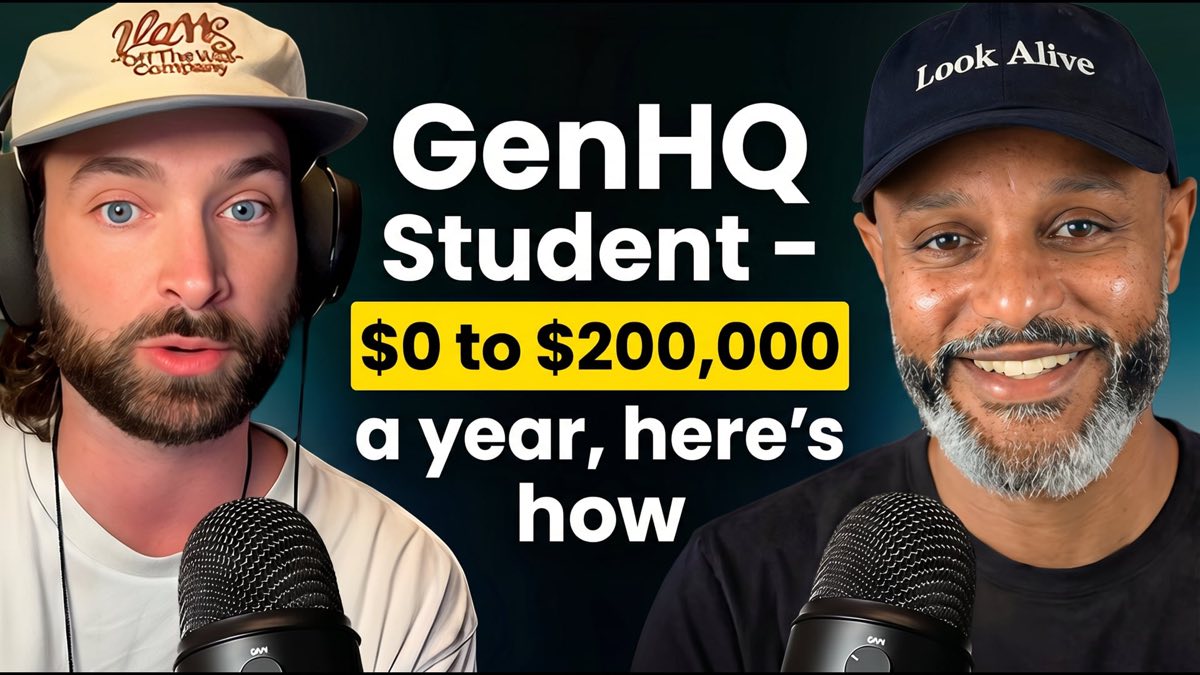
From a $500 Video to a $200K Year: What AI Ad Work Actually Pays
The most common question in AI creative work is not "which tool." It is "what do I charge." And almost everything written about it is theory from people who have never invoiced a client.
So here is the actual pricing ladder of one GenHQ member, Ahmed, from his first $500 video to a year tracking around $200K. I know these numbers are real because I watched them happen, and two of the price jumps came out of conversations he and I had directly.
Where he started
Ahmed was a product designer who became a front-end developer because he was tired of watching developers mangle his designs. No film background. No ad agency history.
When Veo's API went public, he wired it into an automated workflow, generated a video, and posted it on LinkedIn for fun. It went viral, and his DMs filled with CEOs, CMOs and heads of marketing asking the same question: can you make this for us?
You genuinely never know who is watching. But notice what actually happened there: he did not pitch anyone. He posted work, publicly, and got found.
Deal one: $500, and why that was the right price
His first paid video was $500. He picked the number by throwing it out and seeing if the client agreed. It took him eight days to deliver.
Here is the part most beginners get wrong. Ahmed did not think $500 was the value of the work. In his words: the money was not the point, the logo was. A real brand, paying real money, sitting in his portfolio. That is what the first deal is for.
The mistake he sees new creators make is comparing themselves to people a year ahead, hearing the big numbers, and refusing to start small. Start small once, on purpose, and collect the proof. My own number for a first project is $800 to $2,000, on something you can turn around inside a week. Ahmed came in under that, and he took it knowingly, because he had decided the logo was worth more to him than the margin.
Deal two: 72 hours, and the price he almost didn't ask for
The same client came back with an urgent one: a complex announcement video for a funding raise, needed in three days.
Ahmed knew the video was worth real money and had no idea what to ask. We talked it through, and my advice was simple: five grand, do not go below. He sent the price. The client went quiet, and he closed his laptop convinced he had blown it.
They came back. They negotiated a little, and the deal closed in the mid four thousands. He delivered in three nights of barely sleeping, the announcement ran on French television, and the video was everywhere by morning.
Then he did the smartest thing in this whole story: he posted the story behind the video on LinkedIn. Not "look what I made," but three nights, a raised round, a 72-hour deadline, delivered. The DMs that followed were bigger brands, bigger budgets.
The €40,000 contract
Ten days after joining the community, Ahmed landed a €40,000 AI ad contract. I posted it in our wins feed the day it happened, and that post is still there with the date on it, the way every win in GenHQ is documented.
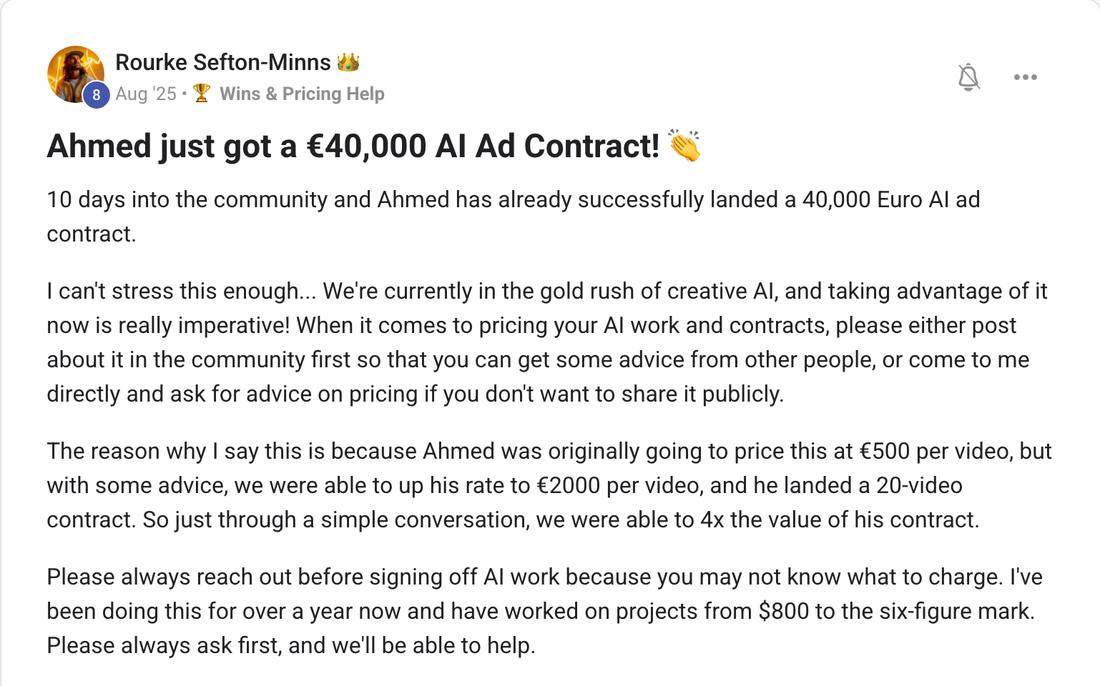
The wins and pricing feed, August 2025.
Read what that post actually says, because the whole lesson is sitting in one paragraph. Ahmed was going to quote €500 a video. He asked in the community first. We talked it through, the rate went to €2,000 a video, and he signed for twenty videos. Same client, same work, same skill level. One conversation, four times the contract.
That is the part nobody puts in a pricing guide. Most of the money you leave on the table is lost in the ten minutes before you send the number.
From there the compounding took over: an e-commerce and SaaS client roster, work with a fast-growing agency he met through a connection made inside GenHQ, and a system his team built that finds freshly funded startups and offers them launch videos. Founders talk to founders. The work now finds him.
How he prices today
Ahmed's pricing now has one rule: value, not hours. He does not bill for time or list the tools. He prices what the video is worth to the business buying it.
And the market context backs him up. As of mid-2026, agencies in the US are paying AI creators in the range of $700 to $1,000 a day, and full-time AI creative roles are listing at $150K and up. The money in this space is real. What separates the people earning it is rarely the generation skill. It is the client skill.
His rules, in case you want the shortcut
Never discuss price on the first call.The first conversation is for understanding their bottleneck. The price goes in the follow-up email, after you have done your research.
Nobody cares how expert you are on the tools.Clients care whether you understand their problem. Ask what is broken, study their competitors, then propose.
First deal buys the logo, not the money.Price it to win, deliver past the promise, and put the brand on your portfolio.
Post the story behind the work, not just the work.The struggle is what people share, and shared work is how clients find you.
Get found, don't chase fame. One viral LinkedIn post did more for Ahmed's pipeline than any outreach campaign.
Where this gets taught properly
Everything above is the story. The teaching lives inside GenHQ: the full hour-long interview where Ahmed breaks down every deal and every price, a complete series on winning clients and getting hired, and a module where Simon, one of the top AI commercial directors in the world with around $300K in competition wins, builds an ad from scratch and walks through every decision. When members are unsure what to quote, they ask in the wins and pricing channel and get answers from people who closed a deal that week.
Individual results vary, and Ahmed put in the reps. What does not vary is the pattern: post publicly, price on value, and treat the first small deal as tuition.
Common questions
What should I charge for my first AI video?
More than you think, and never by the hour. For a first project the range I teach is $800 to $2,000 for something you can deliver inside a week, and closer to $3,000 if the piece runs two to five minutes. Ahmed took $500 for his, under that floor, because he wanted the brand in his portfolio. But the first number matters less than what happens after it. You get compoundingly more valuable with every project you deliver, so when that client comes back a month later you are not the same creator, and the price should not be the same. The first client is a stepping stone, not a rate card.
How do experienced AI ad creators price?
On value to the client, not hours or tools. As of 2026, working day rates in the space run $700 to $1,000 at the agency level, and complex branded videos close in the four and five figures.
Can you actually make a living from AI video?
Yes, and the ceiling is higher than most expect: real creators are running six-figure years within 12 to 18 months. But the income follows client skills, positioning and consistency in public posting, not tool knowledge alone.
Ready to see the receipts?Join the community.